Monday, November 23, 2009

DARPA, GPS, and the wax cylinder

One of the listeners of my recent NPR interview has taken me to task for suggesting that DARPA (the subject of my new book) was crucial to the development of the Global Positioning System.

Roger Easton, Jr., professor at the Center for Imaging Science at the Rochester Institute of Technology, points out that the early DARPA-funded system on which I based my contention, TRANSIT, used an entirely different technology for establishing the location of ground receivers than today's GPS.

While TRANSIT was the first satellite positioning system (with launches beginning in 1959), its reliance on less-than-precise doppler shift measurements was rendered obsolete by later satellites using transmitted time signals for determining position. As Easton put it to me:
It is imprecise at best and incorrect at worst to say that Transit was a predecessor to GPS—the idea really did come from the Navy rather than from DARPA. To me, this would be akin to saying that Thomas Edison had a vital role in developing the iPod because his wax cylinder system was also capable of recording and playing back music.
Not incidentally, Easton is the son of Roger Easton, Sr., one of the pioneering Naval Research Laboratory engineers behind the idea of using satellite time signals (as in today's GPS) for navigation. In fact, Easton, Sr. holds a patent for the idea, "Navigation Using Satellites and Passive Ranging Techniques," number 3789409, filed in 1970.

Thanks for the correction, Dr. Easton. I'll be more nuanced in future statements (DARPA funded the first satellite navigation system, not GPS, along with the first small, lightweight GPS receivers, paving the way for wide use). I'll also correct the next edition of the book.

Tuesday, November 17, 2009

NPR interview and Department of Mad Scientists excerpt


You can now hear me on demand, talking about my new book on DARPA, The Department of Mad Scientists, on National Public Radio's All Things Considered.


Also on that page is the opening of the first chapter, which is about DARPA's Revolutionizing Prosthetics program.

The program is the most ambitious artificial limb project in history, devoting some $100 million to building an arm the looks, feels, and wears like a native arm.

Want more? Listen to me read from the intro in a clip on my home page:

Monday, November 09, 2009

I'm not texting, I'm driving!

Check out this video from a group of National Instruments engineers who rigged up a remote controlled car with an iPhone as the controller.


NI press rep Trisha McDonell tells me there are practical uses for this project: "these applications can help in autonomous vehicle research which are used in rescue missions."

Looks to me like these guys are just having a ball taking texting and driving to a whole new level. DO try this at home, they say. Just don't sue us if you run yourself over!

Thursday, October 29, 2009

Happy 40th birthday, Internet!

Seed magazine has posted an excerpt from my new book about DARPA in honor of today's anniversary of the first connection on the Internet.

No, no, it wasn't Al Gore who created the Internet. It was the Advanced Research Projects Agency, today known as DARPA. Way back in 1969, a couple of researchers at UCLA sent the first message between networked computers of disparate types. It was part of a project called the ARPANet, which formed the basis of the modern Internet.

Saturday, October 24, 2009

DARPA book now available


My book on the Defense Advanced Research Projects Agency (DARPA) is now available in print, electronic, and audio form.

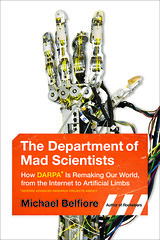
The Department of Mad Scientists: How DARPA Is Shaping Our World, from the Internet to Artificial Limbs is the first mass market book on the Department of Defense Agency that gave the world the Internet, GPS, stealth technology, and lots more.


Listen to me read in this excerpt from the unabridged audiobook and then browse the printed version.

Thursday, October 15, 2009

Quantum to Cosmos Festival


The Quantum to Cosmos Festival starts today in Waterloo, Ontario, Canada. It's ten days of presentations, panel discussions, movies, demos, and a whole lot more sponsored by the Perimeter Institute for Theoretical Physics.

You can catch most of the events live online at the festival website at http://q2cfestival.com/. For instance, tonight at 7 Eastern, 10 physicists talk about the future of their field.

Tune in to XPRIZE founder and CEO Peter Diamandis on Sunday at 1:00 PM. His topic: "The Best Way to Predict the Future is to Invent it Yourself!"

I'll be there starting on Thursday, October 22 at 8:00 PM on a panel with Hod Lipson, Eliezer Yudkowsky, and Cory Doctorow on the Robotics Revolution and the Future of Evolution, which will also be broadcast as part of The Agenda with Paikin throughout the Toronto area.

Friday, October 09, 2009

2009 Popular Mechanics Breakthrough Awards

Last night at the Popular Mechanics Breakthrough Awards, Dean Kamen delivered the most eloquent appeal for getting kids interested in science and technology I've yet seen.

His remarks took the form of his acceptance speech for the Leadership Award. He was speaking off the cuff, but this is something he's been thinking about and actively working on for the last twenty years.

"This biggest problem this country has is a cultural problem," he told the gathered award winners and guests. The problem as he sees it is that we idolize entertainers and sports figures instead of "things that matter."

"We will make clean energy for everybody," he said, "for the six billion people. We will bring into reality all the things that we're now talking about. But to really make that happen, to dramatically increase the odds of that happening, the first thing that we need to do is mobilize way, way, way more kids to really embrace what is on the pages of Popular Mechanics."

Who's telling kids, particularly women and minorities and inner city kids around the united states, 'these other things, they're fun, they're pastimes, you know, but the probability you'll ever make money in sports is way lower than the probability you'll win the state lottery? If you want to develop a muscle, how about trying to exercise the one between your ears? Besides, thinking is the only sport where humans play in the unlimited category. I mean, you think that football player's big and tough, put an elephant on the field. You think that track star is fast, put a gazelle on the field.'

That's why Kamen has developed robotics as a contact sport for students, called FIRST (For Inspiration and Recognition of Science and Technology).

Meantime, Kamen's company, DEKA Research, and all the other award winners brought their inventions to show off--including, yes, this flying car by Steve Saint parked in front of PM headquarters, the Hearst Tower.

One of the demos was hands on; I got to try out the future of video games, Project Natal. It's a system, built for the Xbox 360, that uses the human body as the input device. No more mashing painful little chicklet buttons in arcane combinations to punch, fly, shoot, or whatever. I drove a video game car simply by making steering motions with my hands and thrusting my foot forward to operate an imaginary gas pedal. It's the iPhone of the video game world, and it will instantly render all other systems obsolete.